I attended Gary King's car get-together at his shop at G-Rides on May 8, 2010. There were several Porsches, a Viper, a couple of Ferraris, a hand-control-adapted Nissan 370Z and several other beautiful cars. He also had some vendors in attendance including Brembo brakes (and the rep was a woodworker!) and a very cool battery charger/conditioner product called Save-A-Battery.
I was discussing the 914 conversion to electric drive project with the rep from the charger company when Milt Worthy joined the conversation. Milt is the Co-Editor of the "Coastalaire", the newsletter of the California Central Coast Region of the Porsche Club of America. As we got deeper into the conversation, Milt asked if he could write an article about my restoration and electric conversion project in the June issue. I said sure, and we met later the next week for about an hour to go into more detail about the project. Two days later Milt emailed me the proposed story and I was amazed at his skills as a writer. CCA region members should be receiving their printed newsletter soon, but the article is already available on page 13 of the June 2010 newsletter.
Thanks to Milt for his interest in the project, and getting the word out to the other members of the local Porsche Club chapter.
Saturday, May 29, 2010


Monday, May 24, 2010
First View of the Metal Work
I stopped in at the body shop on the way to work this morning and met Mike for the first time. He had already repaired the caulking hole behind the passenger door latch, and was making progress on the other places as you can see below.


After the metal work is done, it will go off for blasting to get down to the metal, then priming, painting and clearcoat.


After the metal work is done, it will go off for blasting to get down to the metal, then priming, painting and clearcoat.
Friday, May 21, 2010
It's At the Body Shop!
I finally got the entire car stripped and ready for the body shop. My neighbour helped me get the car down to Rainbow with his flatbed trailer. Here she is ready for the trip.


Tom Stainbrook, owner of the Rainbow body shop, said he's bringing in his brother Mike to repair the rusty metal, as he's the best metal guy on the team. Mike starts work at 6AM, so I should be able to stop in for quick visits on my way to work.


Tom Stainbrook, owner of the Rainbow body shop, said he's bringing in his brother Mike to repair the rusty metal, as he's the best metal guy on the team. Mike starts work at 6AM, so I should be able to stop in for quick visits on my way to work.
Saturday, April 10, 2010
At Long Last, Ready for the Body Shop
Sorry for the long time between posts, but not much has happened physically on the car. Our winter was very rainy so I didn't get a lot of good weather to do work on the car. I did spend a lot of hours on improving the code for the Android battery pack monitoring app though. It's pretty much ready to go, waiting for real batteries to watch.
When the weather broke a couple of weekends ago, I dove back in and removed the flywheel from the engine. I installed the flywheel lock and it came off very easily.

Then I got the rest of the car stripped. The only stuff I can't remove is:
- wiring harness - don't want to pull it if I don't have to as it snakes all over the car
- brake fluid reservoir and brake lines - again, don't want to
- drive shafts - the axle nut is frozen on both shafts. I've tried WD-40, Liquid Wrench, a heat gun and a 2' breaker bar on the socket. I hope the body shop can get these off because I'd like to clean them up.
I've found a highly recommended body shop right here in town - Rainbow Marine/Auto Body & Painting. No web site, but phone is (805)239-3791. They're going to media blast, repair the rust spots, prime, undercoat, paint and clear coat it. My buddy Gary at G-Rides does a lot of work on a Porsche Turbo that is painted "Meteor Grey Metallic". It still keeps the silver theme on my car, but a darker, more metallic shade. I think it will look really good.
Here are a few pictures to show the state of the car before it goes off to the shop. I promise I'll peel off the carpet first!


Well that's it. More details as the shop gets to work.
When the weather broke a couple of weekends ago, I dove back in and removed the flywheel from the engine. I installed the flywheel lock and it came off very easily.

Then I got the rest of the car stripped. The only stuff I can't remove is:
- wiring harness - don't want to pull it if I don't have to as it snakes all over the car
- brake fluid reservoir and brake lines - again, don't want to
- drive shafts - the axle nut is frozen on both shafts. I've tried WD-40, Liquid Wrench, a heat gun and a 2' breaker bar on the socket. I hope the body shop can get these off because I'd like to clean them up.
I've found a highly recommended body shop right here in town - Rainbow Marine/Auto Body & Painting. No web site, but phone is (805)239-3791. They're going to media blast, repair the rust spots, prime, undercoat, paint and clear coat it. My buddy Gary at G-Rides does a lot of work on a Porsche Turbo that is painted "Meteor Grey Metallic". It still keeps the silver theme on my car, but a darker, more metallic shade. I think it will look really good.
Here are a few pictures to show the state of the car before it goes off to the shop. I promise I'll peel off the carpet first!


Saturday, January 9, 2010
Launch of Development of the PakTrakr application
Sorry for the long wait between posts. I spent a week at the insanity called Disneyland, then had a very relaxing week between Christmas and going back to work on January 4. I didn't do any physical work on the car in that time, but I did spent a lot of time on the development of of a program that reads the data out of the PakTrakr battery monitoring system that I'll be buying later on in the process. The PakTrakr has a small dashboard display, but it also outputs a data stream each second on a serial port. My idea is to read that raw data and build an application that would show the data in an improved manner, and also derive important user information like distance to "empty".
See this blog post for the details on my choice of device.
I first had to download and install the free software development kit. Then I started playing with sample code, and slowly build up the features of my application. After a couple of weeks of learning, searching and experimentation, I've got a lot of stuff done. I ported the PakTrakr parsing code from Doug Teeple. I then built the application skeleton based on a series of tabs. The first tab will exploit the GPS and mapping functionality to track the progress of each trip:


The next tab will show a list of current and past problems with the batteries. I'm still working on that so there's nothing to show.

The last tab will show the settings controls. Right now, most are used only during development of the code, but others will be used in the course of running the app during driving and charging.
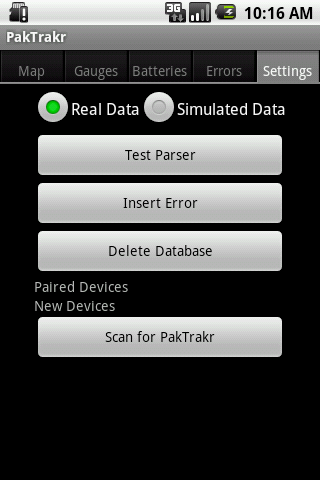
More updates on the code as things progress.
See this blog post for the details on my choice of device.
I first had to download and install the free software development kit. Then I started playing with sample code, and slowly build up the features of my application. After a couple of weeks of learning, searching and experimentation, I've got a lot of stuff done. I ported the PakTrakr parsing code from Doug Teeple. I then built the application skeleton based on a series of tabs. The first tab will exploit the GPS and mapping functionality to track the progress of each trip:

The next tab will show the readings of the battery pack as a whole, in analog gauge format. I couldn't find any gauge controls in the Android toolkit or on the web, so I wrote my own. There's a Percentage of Charge gauge, pack temperature, pack voltage and another custom gauge I wrote that shows the flow of current into the pack during charging, or out of the pack during driving:

The next tab will show the details on each battery in the system, with voltage readings and any errors:

The last tab will show the settings controls. Right now, most are used only during development of the code, but others will be used in the course of running the app during driving and charging.

Monday, December 14, 2009
Drop The Engine!
With the 12-point star driver in hand, it was time to do the biggest project yet - dropping the engine and transmission out of the car. The engine and transmission actually drop out of the bottom of the car, not pulled up from the top like most other cars. Having read the other conversion blogs, I figured I could drop it down gently, but it didn't turn out quite that way...
Fred came over on Sunday, bearing pizza. Feeling satisfied after a good lunch, we laid out our strategy.
First we removed the axles from the transmission at the CV joints. Using the star driver, it was easy. The driver's side axle can be locked with the emergency brake, but on the passenger side I had to wedge my knees against the wheel and hold it with my hands. The important thing is to put a bag over the axle end because it's a greasy mess. You can zip-tie the passenger axle to the spring to keep it out of the way, but the driver's side is impeded by the starter motor. You just have to work around it as you roll the engine out.
I have two hydraulic jacks, as you can see below. We used a furniture dolly and two 2x4s, and brought the jacks up to just take the weight of the engine + transmission.


Fred came over on Sunday, bearing pizza. Feeling satisfied after a good lunch, we laid out our strategy.
First we removed the axles from the transmission at the CV joints. Using the star driver, it was easy. The driver's side axle can be locked with the emergency brake, but on the passenger side I had to wedge my knees against the wheel and hold it with my hands. The important thing is to put a bag over the axle end because it's a greasy mess. You can zip-tie the passenger axle to the spring to keep it out of the way, but the driver's side is impeded by the starter motor. You just have to work around it as you roll the engine out.
I have two hydraulic jacks, as you can see below. We used a furniture dolly and two 2x4s, and brought the jacks up to just take the weight of the engine + transmission.

I removed the two bolts holding the engine brace, then the two nuts holding the transmission, and in 5 minutes the engine is no longer attached to the car. The plan was to drop the front by a few millimeters, then the back, then the front, etc. That worked well for an inch or so, but then the front jack lost its lock and slipped all the way down. We tightened it up and jacked it back up about six inches. We then dropped it evenly until the back jack was down as far as it would go. We let the front down all the way, then brought that jack around to take the load off the back, then gently let the back down. Whew! Would have been better to have two of the blue style jacks, but it worked out.
A final issue popped up - even with the car up on jack stands, the car body was a few inches too low to roll the engine out. We thought about using the hydraulic jack to raise each side and get a few more clicks on each jack stand, but that would involve a stack of 2x4s to get the needed height and I wasn't comfortable with that. Then I remembered we had just taken several hundred pounds of the car, so I walked around to the back and lifted the car up. It actually went up a few inches, so Fred raised the jack stands on each side as I lifted. That gave us the extra space we needed. I carefully rolled backwards, maneuvering around the driver's side axle and the tubing on top. And here we are!


The engine and transmission are strikingly big for the place where they fit in the little car - hard to believe the clever Germans actually fit it all in. Here's the big empty space from above and below.


We still had some light left, so we decided to pop the transmission off the engine. I'll reuse the flywheel, clutch and transmission with the electric motor. That way I can shift it like a normal car if needed. There are four bolts holding the transmission to the engine. We got three of them off easily, but the head of the fourth bolt was obscured by where it's located on the starter motor flange, and we couldn't get a socket or open-end wrench on it. After some creative metalworking (because I won't be reusing the starter), we got the bolt out but discovered that this bolt is very long, and goes all the way through the engine mount to an exposed nut. All we had to do was back the nut off from the other side. Oh well! We wiggled the transmission a little and it separated from the engine. Fred supported it while I pulled them apart and it came off easily.

Next step is to take the pressure plate, clutch disc and flywheel off the back of the engine. The pressure plate came off easily, after we jammed a 2x4 into the teeth of the flywheel to stop it from spinning. I got some repair receipts with the car that show that the clutch was replaced in the past, and both the pressure plate and clutch disc look great. They're both about .375" thick - I'll have to check to see how that compares with new, or if they should be replaced while I'm in there. Also, they're both clean and dry - no sign of oil leaks that mean that they're ruined.


We tried to work on removing the flywheel, but the 5 bolts holding it on the engine just didn't want to release, even with my cordless impact wrench. We gave it a good spraying with WD-40 and wrapped up for the day. Probably my most productive day so far, and a lot to show for it! I'll have to do some checking to see if there's a trick to get these bolts out. I'll probably need to lock the driveshaft somehow.
Saturday, December 12, 2009
Suspension and Brakes Result, CV bolt tool
The good news is that the brakes had been upgraded to the BMW parts by a previous owner, and no further work on brakes is needed.


The bad news is that the shocks are replacements, but they and the springs are factory spec, and definitely need to be upgraded. Electro Automotive sells upgrades as part of the conversion package, so I will have to go ahead with that.
It turns out that Pelican Parts can no longer supply the 12-point CV joint bolt removal tool, so a quick Google search led me to MetalNerd. They specialize in German car tools and accessories. The order was handled very quickly and I got it in my hands in two days! Fred's coming over on Sunday and we'll get the engine dropped.
Sunday, December 6, 2009
Bumpers and Interior Removal, Brakes and Suspension Check
Yesterday I removed the front and rear bumpers. Very straightforward, no surprises.
Today I worked on pulling the interior. Some easy, some tricky...
First I pulled the two seats, with four bolts each. Then I worked on pulling up all of the carpeting. First I removed the defroster light fixture, then loosened the small setscrews holding the shift knob on, then pulled up the center hump carpet. Then it got tricky because the steering wheel shaft goes through a hole in the carpet, so I had to unbolt the U-joint just above the carpet hole. This was tough as the shafts that come into each side of the joint are quite long. I ended up unbolting both sides, then prying apart the upper fitting until I was able to slide it up far enough so it came off the lower shaft. After that the carpeting pieces came up nicely. Then I removed the seat back panel and the aftermarket 3-point racing harness seatbelts. All of this work led up to the gutted interior. I found a dollar bill and about another dollar in change, so the car is trying to offset the cost of this project!


Today I worked on pulling the interior. Some easy, some tricky...
First I pulled the two seats, with four bolts each. Then I worked on pulling up all of the carpeting. First I removed the defroster light fixture, then loosened the small setscrews holding the shift knob on, then pulled up the center hump carpet. Then it got tricky because the steering wheel shaft goes through a hole in the carpet, so I had to unbolt the U-joint just above the carpet hole. This was tough as the shafts that come into each side of the joint are quite long. I ended up unbolting both sides, then prying apart the upper fitting until I was able to slide it up far enough so it came off the lower shaft. After that the carpeting pieces came up nicely. Then I removed the seat back panel and the aftermarket 3-point racing harness seatbelts. All of this work led up to the gutted interior. I found a dollar bill and about another dollar in change, so the car is trying to offset the cost of this project!

Next I moved on to the steering wheel. I recently bought the required 27mm socket. I quickly realized that the nut was on very, very tight and I had trouble trying to hold the wheel and undo the nut. I finally stuck a 2x4 through the wheel spokes and jammed it down into the passenger wheel well. When it finally let go, it was easy to get off. Then I removed the indicator and windshield wiper controls.

With this pulled, I can see the source of two problems I was having. First, the copper strips that conduct the signal for the horn switch are actually worn through. So those have to be replaced. Second, I found that the auto-return mechanism for the indicator is broken. There were a couple of broken pieces of plastic in the area, so I'll have to see how that can be fixed.
Next I thought you'd like to view the heart of the device that is insanity that is the spare-tire-pressure-driven-windshield-washer-system.

If you zoom in on the picture, you'll see a little black tab that goes into the in-and-out fluid connectors. When you pull on the windshield stalk, this black tab is pressed into the fluid connector, allowing the fluid to flow. Unfortunately, it's bat-shit crazy engineering. I have a couple of choices - I can just leave this alone or remove it and mount a push button switch on the dashboard, or I can track down a 924 windshield control stalk that has an electric switch to drive the washer pump I bought. I'll make the decision later.
Next I checked the springs and struts. They don't look original so I may be in luck here. The springs are .388" thick, so I'll be able to find out what load they can handle.


I'll confirm both of these upgrades with my contact at Strasse Porsche in San Luis Obispo on Monday.
Sunday, November 29, 2009
Engine removal first steps
With the gas tank gone, there is no going back to an internal combustion ride! I began to follow the Haynes manual process for engine removal. It said to remove the hoods, then the battery. First actual work on the engine is to slip off the air hoses and remove the air box. Here we are at that point.

You can see on the far side that the "hell hole" around the battery has been previously worked on, but the rust was building up again on the battery holder itself. Time was right to get this fixed anyway.
In a clear case of "The solution is left to the reader", the Haynes manual says "Working logically, detach the electrical leads which go to the engine from the various looms." Uh yeah, thanks for all of the detail. There are 2 major wiring harnesses: the fuel injector computer and the high voltage to the starter motor on the underside of the engine. Here's the fuel injection computer harness:

Next, the Haynes manual says "Working logically, detach the various vacuum and fuel hoses from the engine." Awesome. So, with this completed, the engine is only held into the car via the underside greasy bits.

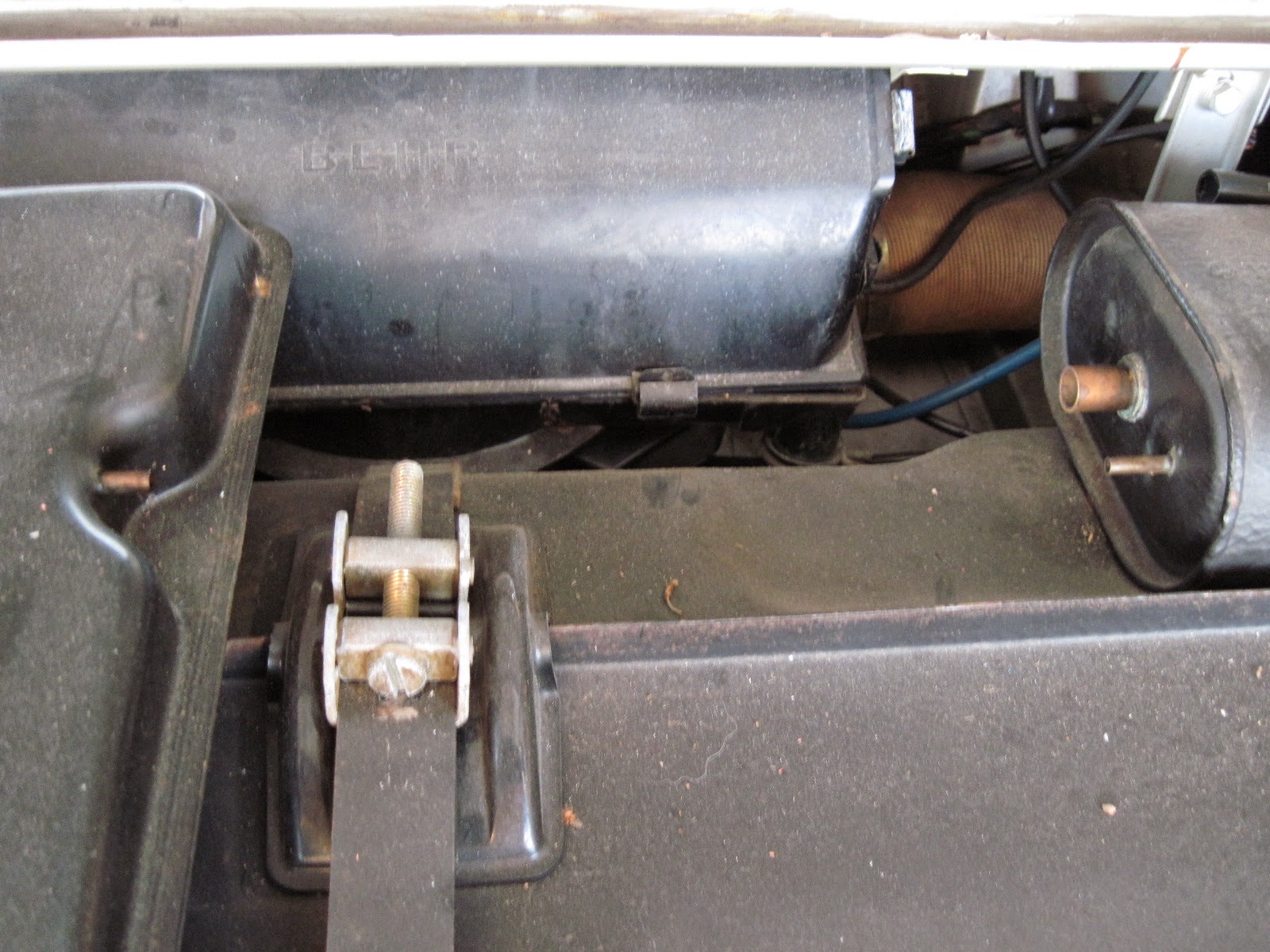
Getting underneath the car, I removed the ground strap, the speedometer cable, the clutch cable and pulley, the gearshift rod and the heater boxes and tubing. The next step in the manual is to remove the driveshafts, but in a stroke of bad planning, I didn't order the special 12-point star bit needed to pull off the CV joints. With a few more hours of sunny and cool Sunday, I decided to pull the exhaust. I had initially thought to leave it attached so I can sell the engine and exhaust as a single piece, but getting underneath and looking at it, I decided it would be a good idea to take it off while I had the chance. The headers and muffler look nearly new which is great, but whoever put it on really didn't do a good job - there were several missing screws and bolts, and one of the sheet metal heat guides wasn't even attached! It was just jammed in place and probably banged around on every bump. One big issue was a missing bolt on one of the exhaust ports! I don't know if it's the way it's designed, but there is no exhaust manifold gasket at all. The fit is tight, but not perfect so I suspect there was a lot of blow-by.

So I ordered the star bit from Pelican Parts and expect to drop the engine next weekend.
Up on Jack Stands, Hood and Gas Tank Removal
Up to now, the car was still driveable. Time to commit to the destruction! First thing to do is get the car up on the jack stands. I used my hydraulic jack to lift up the front driver's corner. I want to put the jack under what seems to be a reinforced metal ring just behind the wheel well. I used a couple of pieces of wood to spread the weight load and got the jack in place, at its lowest height. The car is so small that lifting it this high brought the other side of the car right off the ground too. I went back to the rear driver's corner and lifted it at the metal ring, with the goal of putting the jack stand under the thick pivot arm of the rear suspension. The jack stand has a U-shaped top, so the pivot arm fit perfectly. I then went around and did both corners of the passenger side. It looked like it wasn't high enough, so I made another pass around the car, jacking it up several more inches. And here we have it! I can now comfortably roll underneath with my creeper, and there is sufficient room to drop the engine.


Then it's a matter of removing the spill ring and expansion tank bolted to the top of the main tank.

Then the strap across the tank and the fuel level sender cable connector are removed. At this point, the tank is only in place via two hoses at the bottom. Ignore what the Haynes manual says, and don't bother removing the stone shield under the tank. It's not necessary, and one of my bolts was seized anyway. You can lift the tank up from the passenger side and slide the two hoses off their pipes. If the won't slide easily, cut them off.

And we're done! This is the hole where the gas tank was, and where the electron tank (batteries) will go. If you look closely, you'll see a shiny metal bar going across the front of the area. That's tied to the front suspension on both sides so I suspect it's an aftermarket torsion rod. No wonder the handling felt very tight and stiff! I just hope it doesn't interfere with the placement of the battery holders.


Next came the removal of the front (bonnet) and rear (boot) hoods. This gives complete access to everything that happens from this point on. The hoods are only held on with 4 bolts onto the spring-loaded arms. I think I can leave the front arms in place but the rear arms had to come out. They're only held on with one bolt, but there is a lot of spring pressure, so be careful when they're about to come loose!


Now onto the main event, the removal of the gas tank. It's pretty straightforward. First I had to drain the 5 gallons or so of remaining fuel. I bought a cheap siphon with a primer pump and it took about an hour. If you can, get something that will do the job faster. Also, the hosing wanted to keep its rolled-up form, so I electrical-taped it to a straight stick I found and stuck it straight down the filler hole. Luckily this got nearly every drop out.



Subscribe to:
Posts (Atom)